
To my Litecoin family, and to everyone who builds in this space: this one is for you.
The past few weeks have been crazy. Attacks have hit banks, big companies and media, one after another. In one case, malicious code slipped into the websites of 178 organizations through a popular website tool. Among them was the bank HSBC. The code tried to steal card numbers and even to swap crypto payment addresses for the attacker's own. In another, Visa confirmed an incident at one of its outside service providers, while hackers made claims about more banks that are still unconfirmed.
The old systems are being tested. And in the middle of it all, something beautiful is happening: crypto keeps building.
Crypto keeps building
Every day, I see friends like Wendy O (@CryptoWendyO) highlighting incredible projects.
Wendy O on X
Experts are taking the new threats seriously, too. Cryptographer Eli Ben-Sasson warned on November 5 that AI could help attackers find weaknesses in wallets faster than ever, and pointed to stronger cryptography as part of the answer.
That is fantastic to see. While others react, decentralized projects keep improving.
What a block explorer shows
A blockchain is open. A block explorer is a website that lets anyone look inside it. With one, you can check:
- Any wallet, and how much money it holds
- Every transaction that wallet has made
- The distribution of a coin across all its wallets
- The current block, and every block before it
The block explorer is like the backbone, the spinal cord that holds decentralization together. Nobody has to trust a bank's word. Everybody can check.
That visibility is good, because everything is transparent. But it is also bad for anyone who makes daily transactions. When you pay someone, you don't want them to know how much money you have. You don't want them to be able to trace you. You would never hand a cashier your bank statement.
That is where fungibility fits in.
Congratulations, Litecoin family
I want to congratulate the Litecoin family for never giving up, and for always trying new things in privacy.
MimbleWimble Extension Blocks (MWEB) brought optional privacy to Litecoin. It adds fungibility for those who want it: every coin can be equal, with no history attached. And because it is optional, you choose. Your transactions can stay private, and you can still share them when you need to, for example with an accountant or an auditor.
That makes it less risky for everyday users. Most people looking for privacy are not hiding anything. They simply want the same discretion they already expect from their bank statement.
Built by the community
I also want to celebrate the smaller things the community itself is creating. When something is truly decentralized, everybody owns it, and everybody can build on it.
Today's highlight: the new Litecoin block explorer. It is called Litview (litview.space), and Indigo (@indigo_nakamoto) shared it with the community. It shows the latest blocks in a row across the top, and each block's miner, fees, size and transactions, with a colorful picture of every transaction inside it.
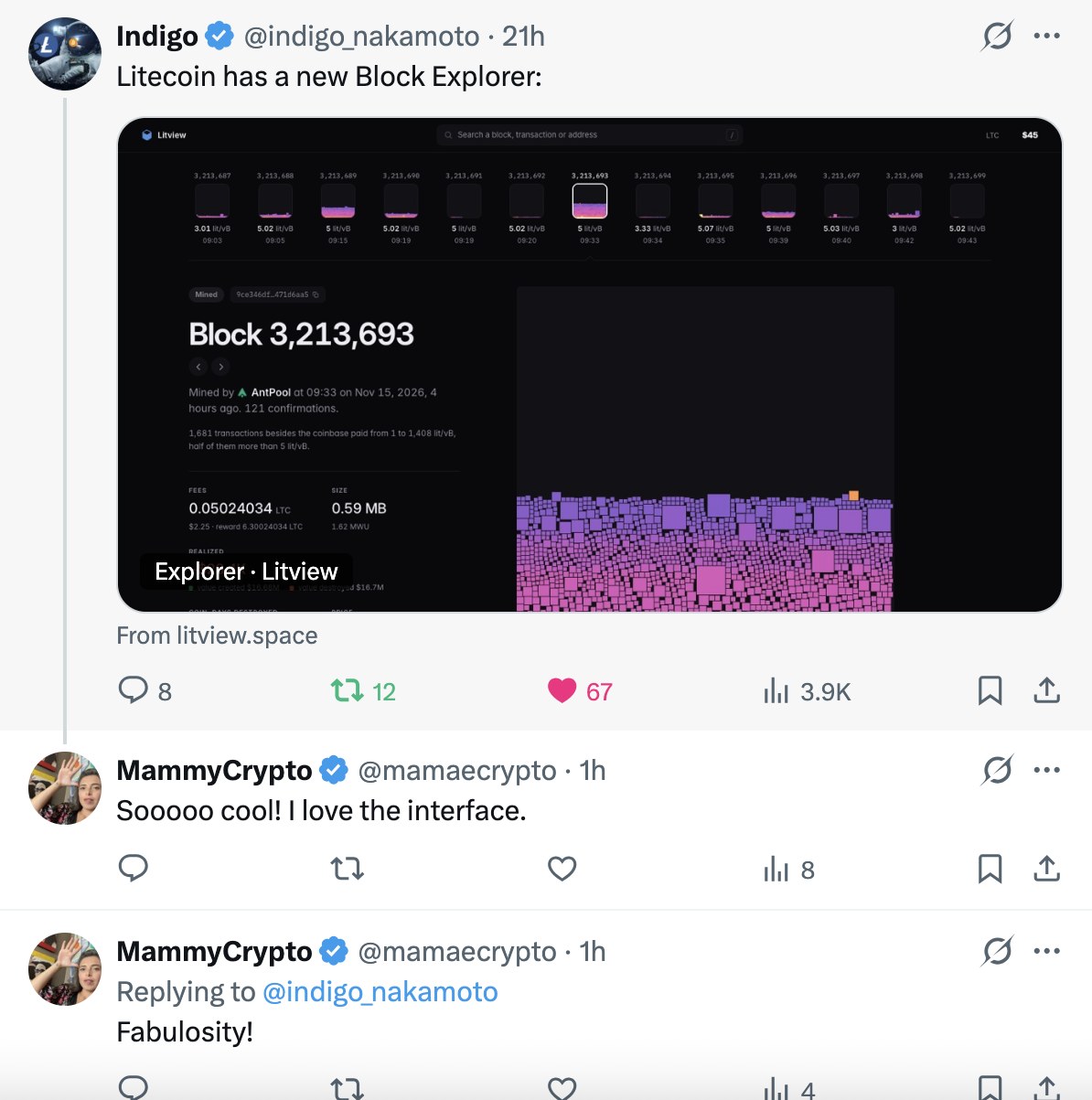
To me, it is a big visual change. The interface is more modern, more current and more relatable to the generation coming up right now. It looks like AI helped make it happen, and that kind of teamwork shows a lot about what the future holds.
And there is more:
- Nexus Wallet (@nexuswallet), a new wallet in the ecosystem
- New wallets expanding into markets like Brazil and Asia, such as Brainwallet (@Brainwallet_App)
It is incredible to watch this ecosystem grow and take shape, ready to support the AI and robotics revolution that is coming.
Looking ahead
Blockchain, decentralization and decentralized coins will probably have an incredible future as we shift into this new society. Nobody has a crystal ball. So let's wait and see, and keep highlighting the things we believe are true to ourselves.
Thank you so much, builders. 🧡
Written by Michelle Mafra (MammyCrypto), with a little help from Claude, a.k.a. Jean-Claude Van Mine, my AI writing partner.
My opinions are my own and not investment advice.
Sources: Cybernews: Optimizely script attack hit 178 major websites · Cybernews: Visa confirms cyberattack as hackers claim JPMorgan was hit too · Crypto Economy: AI security risks (Nov 5, 2026)